

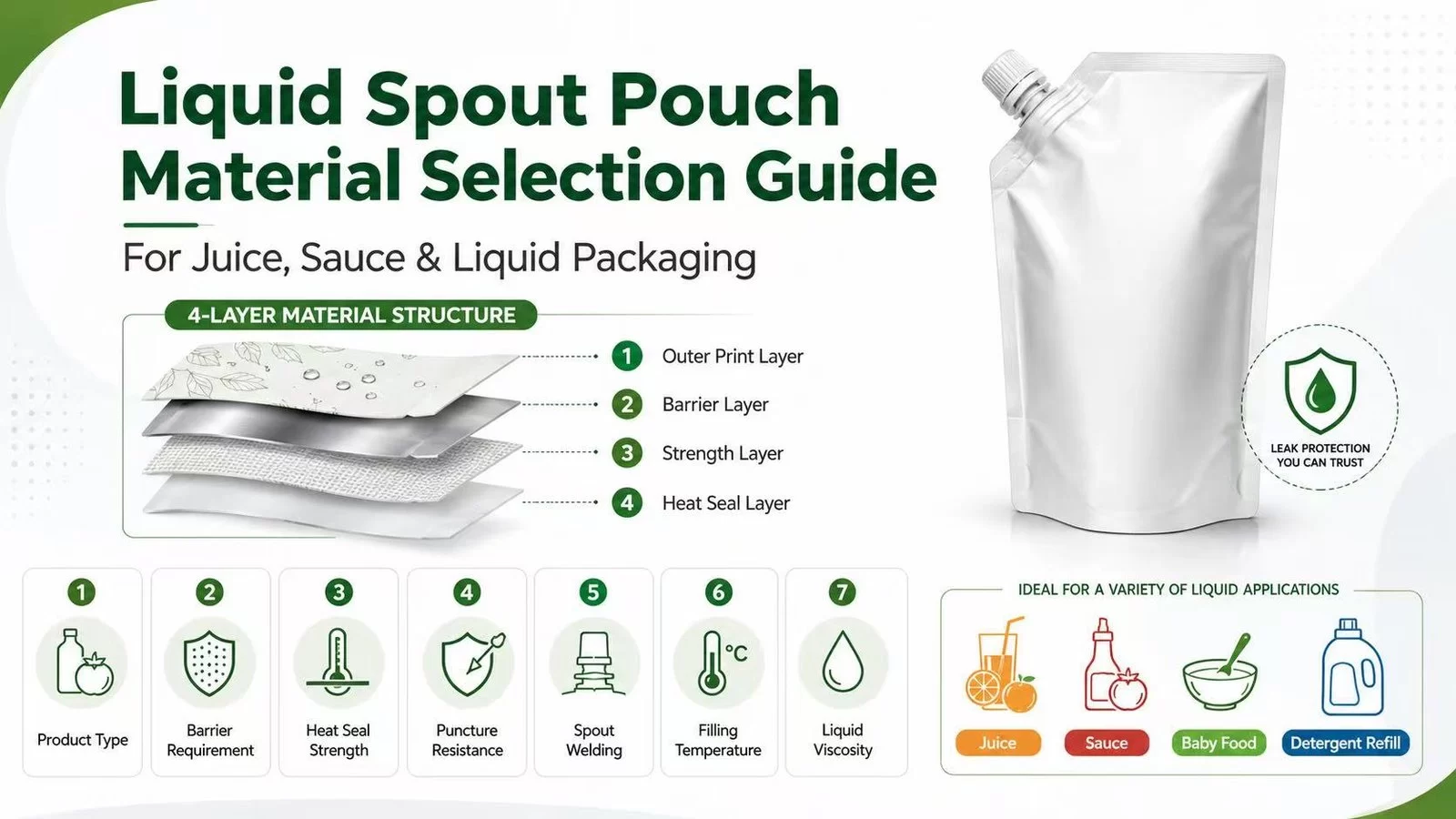
Liquid packaging for juice, sauce, baby puree and detergent refill has stricter structural requirements than ordinary dry food packaging. Liquid internal pressure, long-term standing storage and squeezing during transportation may cause sealing problems if the material structure and spout welding process are not properly matched.
This guide explains how to choose practical materials for liquid spout pouches and what information buyers should confirm before ordering.
Why Liquid Spout Pouches Need Special Structures
Dry packaging usually focuses on basic barrier performance, printing effect and shelf display. Liquid spout pouches must balance three additional requirements: pressure resistance, spout welding strength and stable edge heat sealing.
For example, clear juice needs clean sealing and suitable food-contact inner layers. Particle-containing sauce needs better puncture resistance. Detergent refill pouches require durability and pressure resistance during repeated squeezing. These different requirements mean one universal dry-bag formula is not suitable for all liquid products.
Material Matching for Different Liquid Products
Normal-Temperature Juice and Beverage Pouches
For ordinary juice or beverage products stored at normal temperature, PET / PE can be considered for many conventional applications. The final structure should still be confirmed according to filling temperature, shelf life and target market requirements.
Particle-Containing Sauce and Seasoning Pouches
Thick sauce or products containing small hard particles may scratch or stress the inner film during squeezing. PET / PA / PE is often used when better toughness and puncture resistance are needed.
Baby Food and Puree Spout Pouches
Baby food packaging requires careful food-contact material selection and stable production control. Buyers should confirm product processing conditions, storage requirements and destination market rules before production.
Detergent Refill Liquid Pouches
Detergent refill pouches do not require food-contact materials, but they need pressure resistance, drop resistance and good sealing stability. PET / VMPET / CPP or other durable structures can be evaluated according to the product formula.
Spout Welding and Heat Sealing Points
The spout welding area and pouch edge seals are common risk points for liquid packaging. The spout base must match the film structure, and welding temperature, pressure and time need to be controlled carefully.
For products requiring refrigeration, pasteurization or hot filling, buyers should provide processing parameters in advance. Material structure and sealing settings should be adjusted according to actual working conditions.
Pre-Order Checklist for Liquid Spout Pouches
- Liquid capacity and finished pouch size
- Liquid type: clear juice, thick sauce, puree, particle-containing liquid or detergent
- Storage condition: normal temperature, refrigeration or temperature fluctuation
- Processing method: no heating, hot filling or pasteurization
- Spout position: top spout, corner spout or customized position
- Cap style and diameter requirement
- Special barrier or thickness requirement
- Destination market for compliance confirmation
Get a Custom Packaging Quote
Send us your pouch type, size, material structure, quantity and artwork to get a custom packaging quotation.