

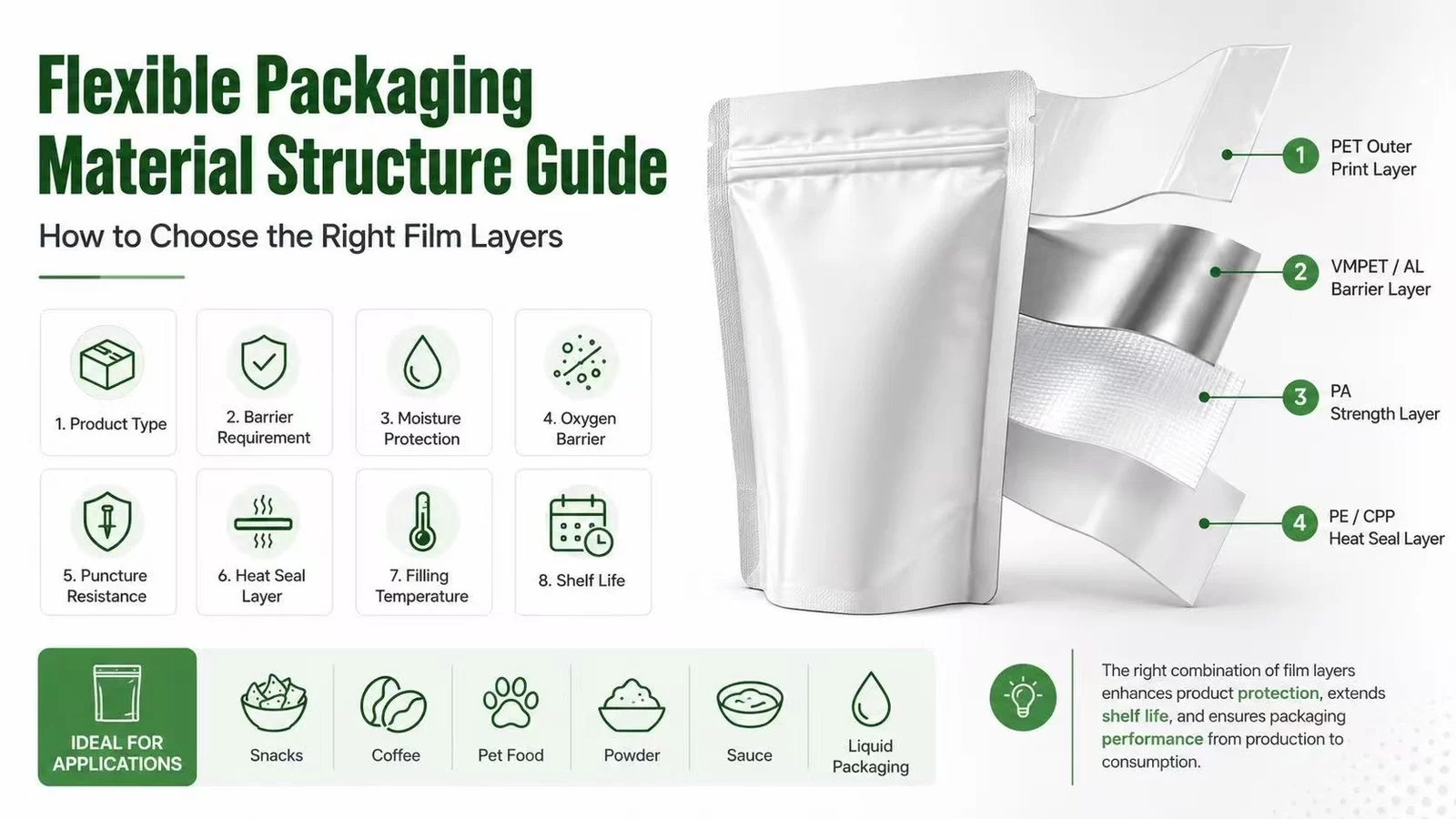
Material structure is the foundation of safe, durable and functional flexible packaging. If the film structure is not matched to the product, common problems may appear, such as weak barrier performance, unstable heat sealing, short shelf-life adaptation or poor resistance during storage and transportation.
Yuesheng Packaging is a custom flexible packaging manufacturer in Shantou, China. We provide multi-layer composite packaging solutions according to product characteristics, filling conditions, shelf-life requirements and destination market requirements.
Common Flexible Packaging Materials and Their Functions
PET: Outer Printing and Protective Layer
PET film is commonly used as the outer layer of laminated packaging. It supports stable printing, good surface gloss and strong tensile strength. In most structures, PET protects inner functional layers and supports customized gravure printing without directly contacting the filling product.
VMPET: Metallized Medium-Barrier Layer
VMPET is a vacuum metallized film with a metallic appearance. It provides moderate oxygen and moisture barrier performance and is often used for cost-effective retail packaging that needs a metallic look and basic fresh-keeping protection.
AL: High-Barrier Light-Shielding Layer
Aluminum foil, usually marked as AL, provides stronger light, oxygen and moisture barrier performance than VMPET. It is suitable for products that require longer shelf life, stronger oxidation resistance or better light shielding.
PA: Puncture and Tensile Reinforcement Layer
PA, also called nylon film, improves puncture resistance and toughness. It is often used for frozen food, particle-containing sauces, heavier products and packaging that may face squeezing during transportation.
PE: Food-Contact Heat-Sealing Layer
PE is a common inner sealing layer for food-contact packaging. It provides stable heat-sealing performance and directly contacts the product in many food packaging structures.
CPP: High-Temperature Resistant Sealing Layer
CPP can provide better heat resistance than ordinary PE in some applications. It is often matched with PET or AL structures when the package needs better temperature stability during processing.
Practical Material Structure Reference
| Product Type | Common Structure | Main Advantage |
|---|---|---|
| Ordinary food snacks | PET / VMPET / PE | Cost-effective medium barrier and stable printing |
| Coffee and high-value dry food | PET / AL / PE | Strong barrier, light shielding and better shelf-life protection |
| Pet food packaging | PET / VMPET / PE or PET / AL / PE | Balanced moisture resistance for dry granules |
| Normal-temperature liquid drinks | PET / PE | Flexible sealing for non-high-temperature liquid packaging |
| Particle sauce or thick liquid | PET / PA / PE | Better puncture resistance and toughness |
| Daily chemical detergent | PET / VMPET / CPP | Durable structure for refill and household packaging |
| Heat-treated packaging | PET / AL / CPP | Improved high-temperature sealing stability |
Key Principles for Material Selection
First, confirm the product attributes. Dry solids, liquids, oily products, acidic products and particle-containing products all require different toughness, barrier and sealing configurations.
Second, clarify shelf-life expectations. Short-term circulation products can often use medium-barrier structures, while products requiring longer storage usually need stronger barrier layers.
Third, consider storage and logistics. Freezing, high-temperature filling, humid warehouses and long-distance shipping may require material adjustments. Finally, confirm destination market requirements before production, especially for food-contact packaging.
Get a Custom Packaging Quote
Send us your pouch type, size, material structure, quantity and artwork to get a custom packaging quotation.