

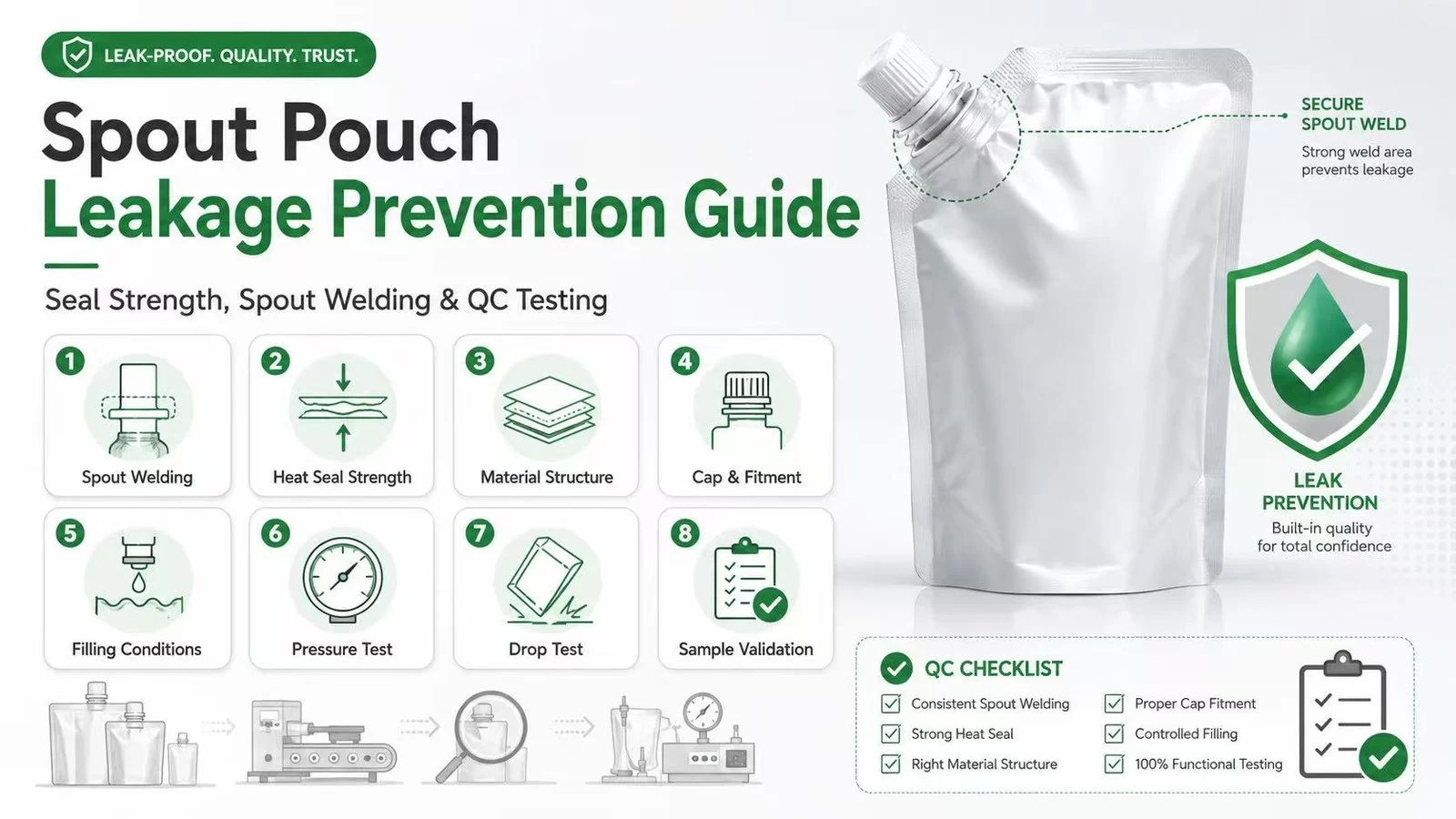
Custom spout pouches for juice, sauce, beverage and daily chemical liquids may face sealing pressure during filling, transportation and long-term storage. Leakage risk can be influenced by material structure, spout welding quality, edge sealing strength and actual usage conditions.
No flexible packaging supplier should promise that leakage risk can be completely eliminated. However, suitable material selection, standardized welding, reasonable structural design and quality inspection can help reduce leakage risk for liquid packaging projects.
Common Leakage Risk Points
Unmatched Material Toughness
Ordinary thin structures may not be suitable for large-capacity liquid, high-viscosity sauce or particle-containing products. If the film is not tough enough, local micro-cracks or weak areas may appear during squeezing or transportation.
Spout Welding Problems
The connection between the plastic spout and the pouch film is a key risk position. Uneven welding pressure, insufficient temperature or mismatched spout base can increase the chance of hidden gaps.
Insufficient Edge and Bottom Sealing Strength
Liquid products put continuous pressure on the side edges and bottom area. If sealing width, sealing temperature or sealing pressure is not properly controlled, edge seepage risk may increase.
Mismatched Filling or Storage Conditions
Hot filling, refrigeration, freezing or long-distance shipping can all affect packaging performance. The material structure should be selected according to actual working conditions, not only by appearance or price.
Practical Ways to Reduce Leakage Risk
Match Material Structure to Liquid Type
Clear low-viscosity liquids may use conventional structures in many applications, while particle-containing sauce or thick liquid often needs stronger film toughness. Daily chemical refill pouches may require thicker or more durable structures for repeated squeezing.
Control Spout Welding Parameters
Spout welding should use matched accessories and stable temperature, pressure and time settings. The welding area should be checked to reduce visible defects and hidden weak points.
Strengthen Edge and Bottom Sealing
For liquid packaging, sealing uniformity is very important. Wider or reinforced sealing design can be evaluated according to pouch size, capacity and product viscosity.
Suggested Quality Inspection Checklist
- Spout welding area visual and bonding check
- Side edge and bottom sealing uniformity check
- Cap opening and closing fitment check
- Sampling pressure or squeezing test
- Filling simulation or standing observation when necessary
- Drop or transportation simulation for selected projects
- Final random inspection before shipment
Information Buyers Should Provide
Before quotation or production, buyers should provide the liquid type, capacity, pouch size, spout position, filling temperature, storage condition and target market. Complete information helps the supplier recommend suitable material and sealing solutions.
Get a Custom Packaging Quote
Send us your pouch type, size, material structure, quantity and artwork to get a custom packaging quotation.